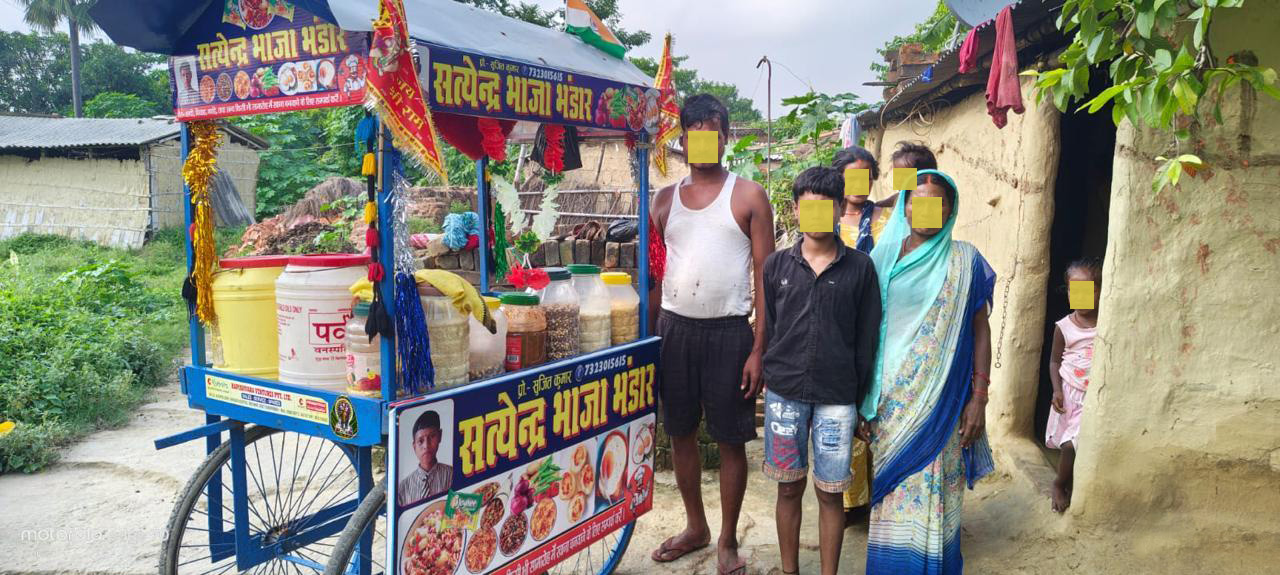
[Image: Example of a trench where bonded laborers are forced to work and the structure where they live.]
Suhani* is a 16-year-old girl from a scheduled caste family in the western region of Bihar. At the time of this story, her family had been living and working under conditions of bonded labor at a brick kiln in Uttar Pradesh, trapped alongside 27 other families who had been there since the fall of 2019. Like the others, Suhani’s family had taken a small advance through a labor contractor, a transaction that became the chain binding them to the kiln. They were denied freedom of movement, forced to work exhausting hours, and never paid the wages they were legally owed. The kiln owner was powerful, politically connected and financially influential, and this power kept the families silent and afraid.
In the spring of 2021, something happened that would change everything.
Suhani was walking to fetch water when the kiln owner’s brother-in-law called her into an office room under the pretense of asking for a drink of water. Once inside, he locked the door and restrained and sexually assaulted her. A family member witnessed her entering the office and immediately ran to tell Suhani’s father. When her father and other workers confronted the man, he and his guards beat them, injuring her father. For Suhani and her family, the assault brought terror, trauma, and a very real threat to their safety.
What the kiln owner didn’t know was that help for Suhani was already on the way.
Before the assault, some of the workers had quietly contacted relatives who had been freed from bonded labor in earlier rescues supported by the local Justice Hub. Trained lawyers and advocates from the Justice Hub had already begun building a case for the families’ release, though the process had been slowed by the COVID-19 pandemic. This new assault became a turning point, making urgent what was already underway.
Freedom
With evidence of both bonded labor and the assault on a minor carefully documented, the Justice Hub coordinated with police and district officials. Four days after the assault, a joint rescue operation was carried out. The team conducted an on-site inquiry and recorded statements from Suhani and her father. Suhani, her father, and two other women workers were then taken to the local police station, where a formal criminal case was filed, covering charges of sexual assault, physical violence, and violations of laws specifically protecting children and marginalized communities from abuse and atrocity. That evening, Suhani received a medical examination and afterward was placed in a girls’ home for her care and protection.
Justice
From that moment forward, the Justice Hub’s lawyers and aftercare team moved together as one coordinated unit — legal advocacy and emotional support running in parallel, every step of the way.
Justice Hub advocates worked closely with investigators to ensure Suhani’s formal statement was recorded before a magistrate, completing the careful legal steps required to protect a minor survivor. She gave her statement with her father present and was placed in his care under the supervision of child welfare authorities.
Between 2021 and 2024, the accused made repeated attempts to obtain bail, pursuing appeals from the trial court to the High Court and ultimately the Supreme Court of India, and Justice Hub advocates opposed every application successfully.
One of the most difficult moments came when Suhani was required to testify in the same courtroom as the man who had assaulted her, facing him directly, without the protection of a separate room or video link. The Justice Hub aftercare team spent months preparing her, building her confidence through regular counseling. When the time came, Suhani testified clearly, consistently, and with courage. Her testimony was a cornerstone of the prosecution’s case.
In the summer of 2024, the court delivered its verdict: guilty. The accused was convicted on all charges and sentenced to 20 years of rigorous imprisonment.
Restoration
A conviction was not the end of the Justice Hub’s work — it was the beginning of a new chapter.
Following the verdict, Justice Hub advocates pursued victim compensation on Suhani’s behalf. An initial award came with an unjust bank guarantee condition that would have been an impossible burden for her family. The Justice Hub challenged it successfully, and through persistent legal effort, the total compensation was ultimately increased to approximately $2,855. The Justice Hub continues to pursue recovery of the remaining amount from the convicted perpetrator.
Alongside the legal work, the Justice Hub provided holistic aftercare support: ongoing counseling, help obtaining identity documents, opening a bank account in Suhani’s name, COVID-19 vaccination support, and guidance to protect her and her family from the risk of re-trafficking.
Today, five years after her rescue, Suhani remains connected to her Justice Hub team. Her family has returned home to Bihar, where they own their house. Her parents work in construction, earning daily wages, and they know their rights. Suhani is married. She supports her household, helps with farming, and has begun saving money in a small piggy bank with a quiet dream of one day starting her own business.
Suhani’s journey is a testament to what justice actually looks like in practice: years of sustained, coordinated effort between trained legal advocates and compassionate aftercare workers, walking alongside a survivor until she is truly free.
*Name changed to protect the survivor.